Master intrigi [P010]
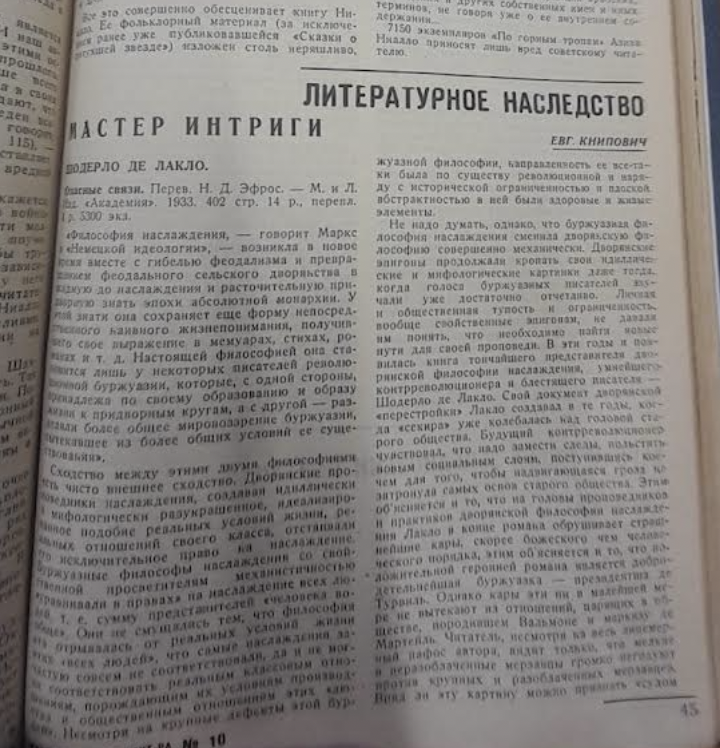
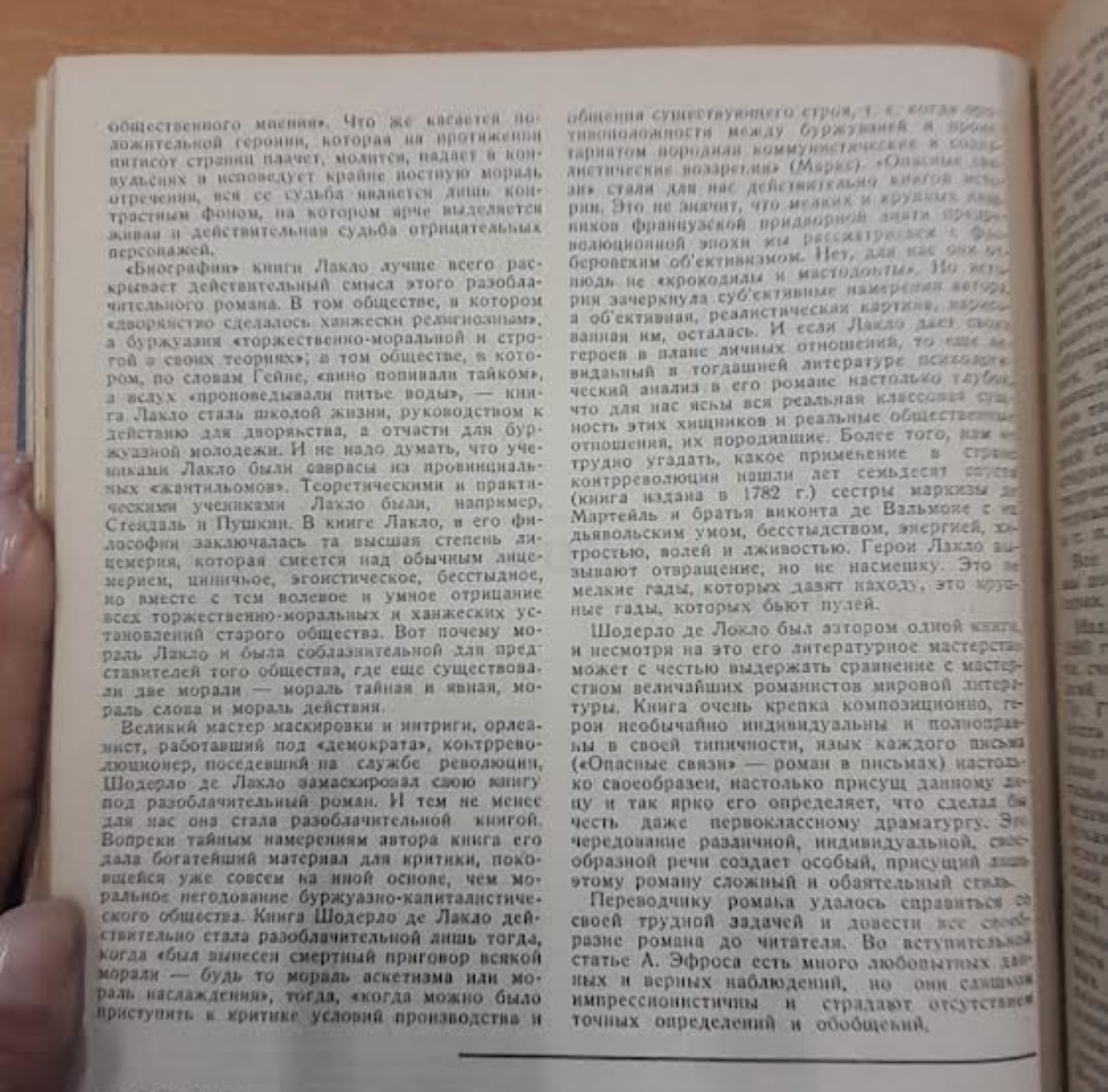
Paratext collocation: "Chudožestvennaja literatura" [rivista], 10 – pp. 45-46
Paratext's typology: Review
Author of the paratext: Knipovič Evgenija Fedorovna
Date of the paratext: 1933
Title of the original work translated into Russian: Les liaisons dangereuses
Publication date of the original work: 1782
Country of the original work: France
Author of the original text: Laclos Pierre-Ambroise-François Choderlos De
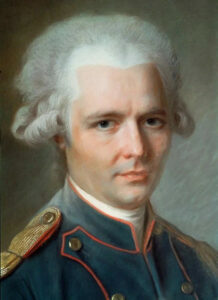
Bio of the Author (original text): French writer, born in Amiens on 18 October 1741, died in Taranto on 5 September 1803. From a family of recent nobility, he pursued a military career and became an excellent artillery officer; secretary to Philippe d'Orléans, during the events of the French Revolution he sided with his faction against the first-born branch of the Bourbons, later siding with the republicans. Imprisoned twice during the revolutionary years, he managed to avoid the guillotine thanks to his artillery skills. He returned to service under Napoleon. He was the author of the epistolary novel Les liaisons dangereuses, the "libertine novel par excellence" according to Laurent Versini's definition, a work that illustrated the licentious customs of the ancien régime nobility by creating the diabolical literary couple Viscount de Valmont - Madame de Merteuil; the novel caused an immediate stir (it was often read by contemporaries as a work à clé) and was condemned in France for immorality from 1823 to 1825, although it went through numerous editions throughout the 19th century. A fundamental book for future French literature, from Stendhal to Beaudelaire to Marcel Proust, this work remains the only authentic literary success of Laclos, who was also the author of the essay Essai sur l'éducation des femmes (1786), first published only in 1908.
Author image:
Title of the Russian translation: Opasnye svjazi
Collocation of the translation: Moskva – Academia
Translator's name: Natal'ja Davydovna Èfros
Translator's bio: Natalya Davydovna Efros (née Galperina), wife of Abram Efros. Born near Voronezh in 1889, died in Moscow in 1989. Natalya Davidovna Efros (née Galperina), wife of Abram Efros. Born near Voronezh in 1881, died in Moscow in 1989. In 1916, she graduated from Moscow University with a degree in History, and already as a student she did literary translations from French, eventually becoming a professional translator. In addition to this activity, from the 1920s onwards she also worked as a teacher at various Soviet institutions and institutes; from the end of the 1920s onwards she was intensively involved in publishing, working as an editor for "Literaturnoye nasledstvo" (1933-1941). During the war she took nursing courses and was then evacuated to Uzbekistan. She returned to Moscow in 1943, where she resumed editorial work (1946-78, in the editorial office of "Literaturnoye nasledstvo"), from '45 also at Sovinformbyuro. From 1954 to 1978 she worked for the Institut mirovoy literatury. She also resumed her work as a literary translator (translating Victor Hugo and Anatole France); in the 1970s she wrote a memoir about her husband A.M. Efros, republished in 2018 under the title Vospominaniya raznych let (Moskva, Noviy chronograf).
Curator of the Russian translation: Èfros Abram Markovič
Russian translation publication date: 1933


Concise description of the paratext-directives' relation:
In a slightly ironic vein, Evgeniya Fedorovna Knipovich (1898 – 1988), a former aspiring poet in the Symbolist sphere, the last companion of Aleksandr Blok, and a literary woman who from the second half of the 1920s undertook a personal ideological ‘reformation’, embracing the new political and cultural course of Soviet Russia (she worked as a literary critic and editor), reviews Choderlos de Laclos’ book, published in 1933. Knipovich chooses a title for her review that is intended to do justice to the French writer’s literary qualities: Master intrigi [A master of intrigue]; after which, she resorts to the well-established technique of ideological validation of her own words, by quoting, in an almost incipital position, from a Marx and Engels passage on the philosophy of pleasure: “The philosophy of pleasure, according to Marx, emerged in the new times with the disappearance of feudalism and the transformation of the feudal rural nobility into a pleasure-seeking and dissolute courtly class typical of absolutism” . However, the quotation appears even more relevant if we examine the literary and critical context in which it is quoted. The excerpt quoted by Knipovich, in fact, comes from the German Ideology, a collection of works by Marx and Engels that had been studied and published for the first time ever in Moscow, and had been in print for less than a year, first in the German original (1932), then in Russian (1933). The publication of this fundamental work was edited by scholars from the renowned research centre Institut Marksa – Engel’sa – Lenina in Moscow. Having framed the “libertine novel par excellence” (L. Versini) within the Marxist-Leninist conception, Knipovich continues her assessment by talking about a book that ‘unmasks’ the vices of aristocratic society, in which the only positive character (albeit, according to her, faint-hearted and boring) is the bourgeois President de Tourvel. Knipovich here uses classic formulas, already inflated in the early 1930s, and traceable to the usual ideological and historical-literary orthodoxy: for him, a book, if ideologically controversial, as the libertine Opasnye svyazi naturally was, had to be at least unfailingly “razoblachitel’niy” (the adjective is used three times in the short text); in the words of the critics: “A great master of disguise and intrigue, an Orleanist working as a ‘democrat’, an ageing counterrevolutionary in the service of the revolution, Choderlos de Laclos wanted to disguise his book as a novel of denunciation. And yet, for us, it is a revealing and exposing book. Contrary to the author’s secret intentions, his book has provided us with a great deal of material for criticism. Knipovich thus already anticipates, even in the very use of the term vopreki (despite), the Lukacsian theory of ‘voprekism‘ (the theory by which it appeared possible to publish/disseminate a particular author and artist (even harshly criticising him) with the ultimate aim of openly proposing him to the Soviet public, a theory formally inaugurated in the journal “Literaturniy kritik” by the famous article, focusing particularly on Balzac. Having thus accomplished the usual formal captatio benevolentiae at the beginning of his article, Knipovich then notes the vividness and realism with which the demonic, terrible characters of the Viscount de Valmont and the Marquise de Merteuil are given, emphasising the psychological depth and three-dimensionality of the characters and events and at the same time the militant and political relevance of the book: “The psychological analysis of his novel, unprecedented in the literature of the time, is so profound that the real class nature of these predators and the real social relations that generated them become clear to us. Moreover, it is not difficult for us to guess what the sisters of the Marquise de Merteuil and the brothers of the Vicomte de Valmont, with their diabolical intelligence, shamelessness, energy, cunning, willpower and deception, were for in the countries of the counterrevolution 70 years later (the book was published in 1782). Laclos’ characters are disgusting rather than mocking. They are not small reptiles that are crushed along the road, but large reptiles that can only be annihilated by a bullet.”In particular the last sentence, with its reference to the small, harmless reptiles (irrelevant enemies) in contrast to the big monsters/reptiles, which can only be defeated with bullets (the selfish, demonic aristocrats of the ancien régime) almost seems to be a reference to the giant, counter-revolutionary snakes of Bulgakov’s The Fatal Eggs, published only a few years earlier. Later in the article, the language and style of the French writer in particular are praised, again often with reference to the principle of realism and tipichnost’: “The book is very strong compositionally and stylistically, the characters are unusually individual and complete in their typicality, the language of each letter (Dangerous Liaisons is an epistolary novel) is so particular, so inherent to the person in question and defines him or her so vividly that it would do credit even to a first-class playwright. the alternation of different, individual discourses creates a special, unique, complex and fascinating style.” (p. 46). There is no lack of appreciation for the translation and the introductory article (however, let us remember at the same time that Knipovich was still in those years part of the inner circle of Lev Kamenev, who in ’32-’33 was director of Academia, the publishing house that had published Laclos’s book), passing only a slight snide remark against the “impressionistic style” and spotty style of Abram Efros’s preface, which, even if it reported “curious data and news, truthful considerations” these were “too impressionistic and suffer from the absence of precise definitions and generalisations”.
Alessandra Carbone