Literatura èpochi pervoj francuzskoj revoljucii [P011]
Paratext collocation: Istorija zapadno-evropejskoj literatury novogo vremeni – Moskva – GICHL – p. 129
Paratext's typology: Teaching text (manual)
Author of the paratext: Šiller Franc Petrovič
Date of the paratext: 1937
Paratextual directives:
Title of the original work translated into Russian: Les liaisons dangereuses
Publication date of the original work: 1782
Country of the original work: France
Author of the original text: Laclos Pierre-Ambroise-François Choderlos De
Bio of the Author (original text):
French writer, born in Amiens on 18 October 1741, died in Taranto on 5 September 1803. From a family of recent nobility, he pursued a military career and became an excellent artillery officer; secretary to Philippe d'Orléans, during the events of the French Revolution he sided with his faction against the first-born branch of the Bourbons, later siding with the republicans. Imprisoned twice during the revolutionary years, he managed to avoid the guillotine thanks to his artillery skills. He returned to service under Napoleon. He was the author of the epistolary novel Les liaisons dangereuses, the "libertine novel par excellence" according to Laurent Versini's definition, a work that illustrated the licentious customs of the ancien régime nobility by creating the diabolical literary couple Viscount de Valmont - Madame de Merteuil; the novel caused an immediate stir (it was often read by contemporaries as a work à clé) and was condemned in France for immorality from 1823 to 1825, although it went through numerous editions throughout the 19th century. A fundamental book for future French literature, from Stendhal to Beaudelaire to Marcel Proust, this work remains the only authentic literary success of Laclos, who was also the author of the essay Essai sur l'éducation des femmes (1786), first published only in 1908.
Author image:
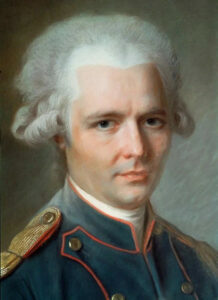
Title of the Russian translation: Opasnye svjazi
Collocation of the translation: Moskva – Academia
Translator's name: Natal'ja Davydovna Èfros
Translator's bio: Natalya Davydovna Efros (née Galperina), wife of Abram Efros. Born near Voronezh in 1889, died in Moscow in 1989. Natalya Davidovna Efros (née Galperina), wife of Abram Efros. Born near Voronezh in 1881, died in Moscow in 1989. In 1916, she graduated from Moscow University with a degree in History, and already as a student she did literary translations from French, eventually becoming a professional translator. In addition to this activity, from the 1920s onwards she also worked as a teacher at various Soviet institutions and institutes; from the end of the 1920s onwards she was intensively involved in publishing, working as an editor for "Literaturnoye nasledstvo" (1933-1941). During the war she took nursing courses and was then evacuated to Uzbekistan. She returned to Moscow in 1943, where she resumed editorial work (1946-78, in the editorial office of "Literaturnoye nasledstvo"), from '45 also at Sovinformbyuro. From 1954 to 1978 she worked for the Institut mirovoy literatury. She also resumed her work as a literary translator (translating Victor Hugo and Anatole France); in the 1970s she wrote a memoir about her husband A.M. Efros, republished in 2018 under the title Vospominaniya raznych let (Moskva, Noviy chronograf).
Curator of the Russian translation: Èfros Abram Markovič
Russian translation publication date: 1933


Concise description of the paratext-directives' relation:
“Already less tied to Rousseauist ideas than other writers in pre-revolutionary France. Here we can mention Choderlos de Laclos. His epistolary novel Les Liaisons dangereuses (1782) shows in minute detail the degradation of the French aristocracy on the eve of the revolution. Choderlos de Laclos, master of the frivolous novel, became a prominent figure in the French Revolution. Equally important (Girondin) was another writer, Louvet de Couvray (1760-1797), author of the famous The Adventures of the Chevalier de Foblas (1787-1789). This novel, written by Louvet in his youth, is devoid of any accusatory character; its success was based on an erotic plot, which often bordered on pornography. The enormous popularity of this work, as well as the erotic poems of Everest de Parny (Parny, 1753-1814), which celebrate the epicurean life of Parisian high society, bear witness to the moods and customs that prevailed in society in the last days of the “ancien régime” (Šiller: 1937, 129).
Alessandra Carbone