Karlo Goldoni i ego memuary [P016]
Paratext collocation: Memuary Karlo Goldoni, soderžaščie istoriju ego žizni i ego teatra, t. 1 – Leningrad – Akademia – pp. 5–15
Paratext's typology: Preface
Author of the paratext: Mokul'skij Stefan Stefanovič
Author's bio:
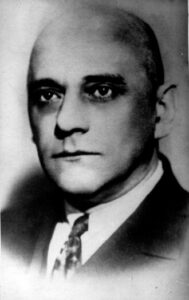
Stefan Mokulsky (1896-1960). Translator, theatre historian and critic, lecturer of theatre history, head of the section of theatre theory and history at the Institute of the History of Fine Arts of the USSR Academy of Sciences. In 1918 he graduated from the Faculty of History and Philology at the University of Kiev, from 1923 he lived and worked in Leningrad, in the 1940s he moved to Moscow. He belongs to the Leningrad theatre school of Gvozdev. In the 1930s, he followed the trends of Friche's sociological criticism. Between 1943-1948, he was director of the GITIS theatre in Moscow; during the same period, renowned scholars such as Dzhivelegov, Radzig, Gukovsky and others taught there. He was dismissed during the fight against the 'cosmopolitans' on the charge of 'anti-partisanship'. He is best known for his research in the field of Italian and French theatre of the Renaissance and the Enlightenment; in the field of Italian literature, in particular for his editing and translation of Goldoni's Memoirs (from the first French edition held at the National Library in St. Petersburg), as well as for a series of studies dedicated to Gozzi and Goldoni.
Bibliography: Ju.B. Bolshakova, Zhizneopisanie S.S. Mokulskogo, sostavlennoe im samim (1921-1949) (po neopublikovannym arkhivnym materialam), "Teatr. Zhivopis. Kino. Muzyka", 4 (2013), pp. 9-16; RGALI F. 2342. Op.1. S.S.Mokulsky, CGALI SPb. F. R-407. Op.1. D.207-212; CGALI SPb. F. R-371. Op. 2. D. 143. Mokulsky Stefan Stefanovich.
Date of the paratext: 1930
Paratextual directives:
Author image:
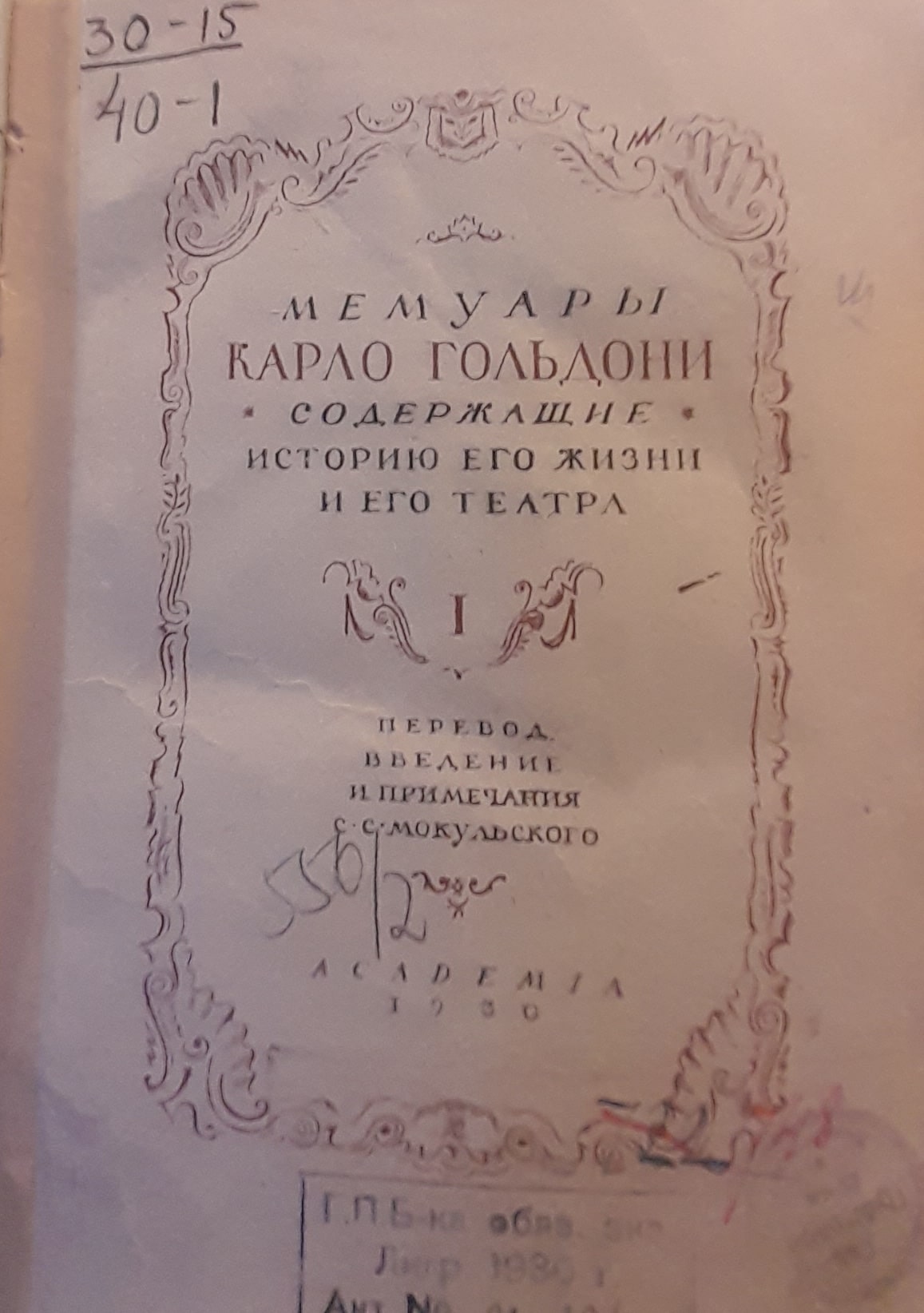
Title of the original work translated into Russian: Mémoires, pour servir a l' histoire de sa vie, et a celle de son théatre
Publication date of the original work: 1787
Country of the original work: Italy
Author of the original text: Goldoni Carlo
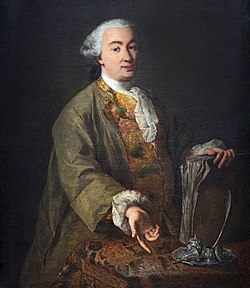
Bio of the Author (original text): Carlo Goldoni (Venice 1707 - Paris 1793). Venetian Enlightenment playwright, reformer of the commedia dell'arte, best known for renouncing masks and developing character comedy. He made his debut on the Venetian stage in 1734, with the popular drama Belisario. His most famous comedies are Il servitore di due padroni, Il cavaliere e la dama, La famiglia dell'antiquario, Le femmine puntigliose, La bottega del caffè, Il bugiardo, I pettegolezzi delle donne, La moglie saggia, Le donne gelose, Le donne curiose, La serva amorosa, La locandiera, Le baruffe chiozzotte. Between 1745 and 1748 he practised as a lawyer in Pisa; in 1748 he returned to Venice. 1749 saw the beginning of Goldoni's fight against the Jesuit abbot Pietro Chiari, and then against Count Carlo Gozzi, a fervent supporter of commedia dell'arte. Gozzi publicly accuses Goldoni of being an incapable and immoral writer and even mocks him in his fables. Exhausted by this conflict, in 1762 Goldoni moved to Paris where he taught Italian to Louis XV's daughter; the French public, accustomed to the improvisation and masks of Italian theatre, did not welcome the reformer benevolently. Goldoni died at the height of the Revolution in poverty, deprived even of his small pension. Goldoni's theatre is characterised by greater realism than the earlier tradition; the comedies are intended for a large, unrefined, often uncultured audience. The language of the characters, which shifts from Italian to Venetian, escapes the literary models in use, revealing itself to be closer to that of the ordinary citizens of the Serenissima; the situations in the comedies are always determined by concrete social contexts (generally typical of the everyday life of the bourgeoisie of the North). Goldoni renounces magical plots and fairy-tale motifs in favour of references to the reality of the present moment, with all the details of simple settings (inn, fishermen's houses, piazza), often considered in the salons of the time as 'low' level. His plays always contain a moral (also made explicit in the author's introductions) and are never intended for pure entertainment; Goldoni hits out at various vices, including hypocrisy, and, while accepting social hierarchies, he praises fidelity to the values of the bourgeois tradition that, according to the author, everyone can follow in their own small way, namely reasonableness, honesty and industriousness.
Author image:
Title of the Russian translation: Memuary Karlo Goldoni, soderžaščie istoriju ego žizni i ego teatra
Collocation of the translation: Leningrad – Academia
Translator's name: Mokul'skij Stefan Stefanovič
Translator's bio:
Stefan Mokulsky (1896-1960). Translator, theatre historian and critic, lecturer of theatre history, head of the section of theatre theory and history at the Institute of the History of Fine Arts of the USSR Academy of Sciences. In 1918 he graduated from the Faculty of History and Philology at the University of Kiev, from 1923 he lived and worked in Leningrad, in the 1940s he moved to Moscow. He belongs to the Leningrad theatre school of Gvozdev. In the 1930s, he followed the trends of Friche's sociological criticism, whereas earlier he was accused of formalism. Between 1943-1948, he was director of the GITIS theatre in Moscow; during the same period, renowned scholars such as Dzhivelegov, Radzig, Gukovskiy and others taught there. He was dismissed during the fight against the 'cosmopolitans' on the charge of 'anti-partisanship'. He is best known for his research in the field of Italian and French theatre of the Renaissance and the Enlightenment; in the field of Italian literature, in particular for his editing and translation of Goldoni's Memoirs, as well as for a series of studies dedicated to Gozzi and Goldoni.
Curator of the Russian translation: Mokul'skij Stefan Stefanovič
Russian translation publication date: 1930


Concise description of the paratext-directives' relation:
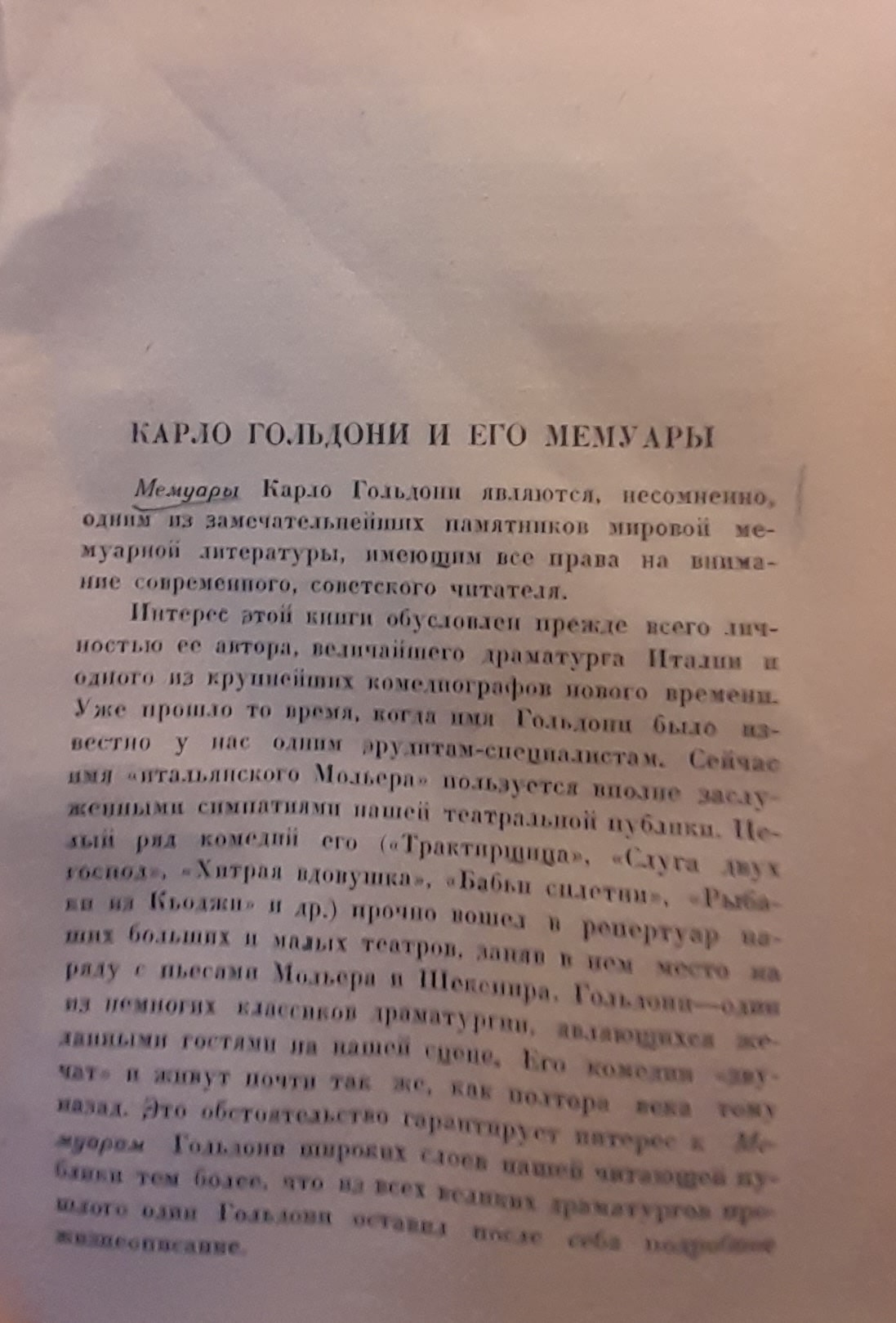
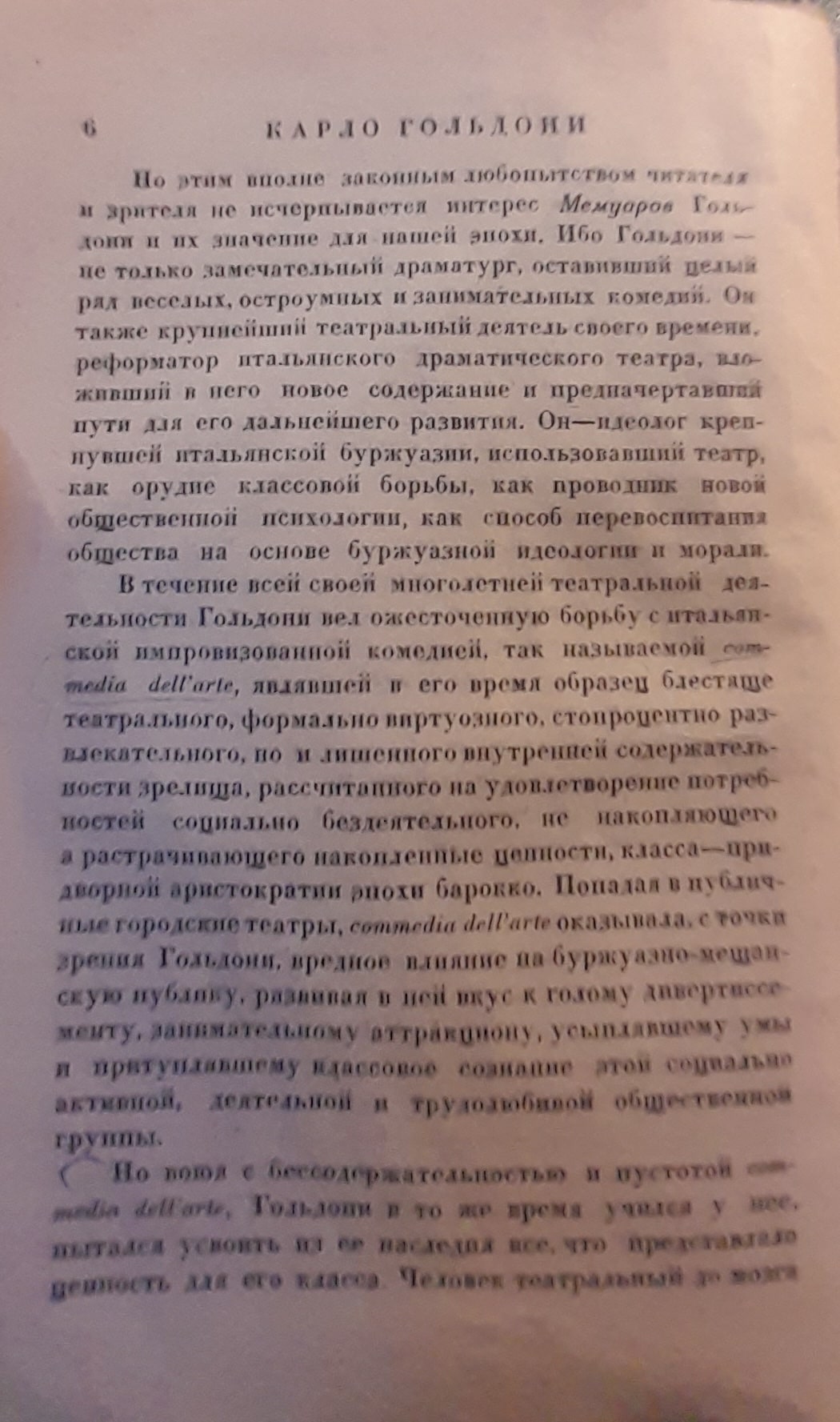
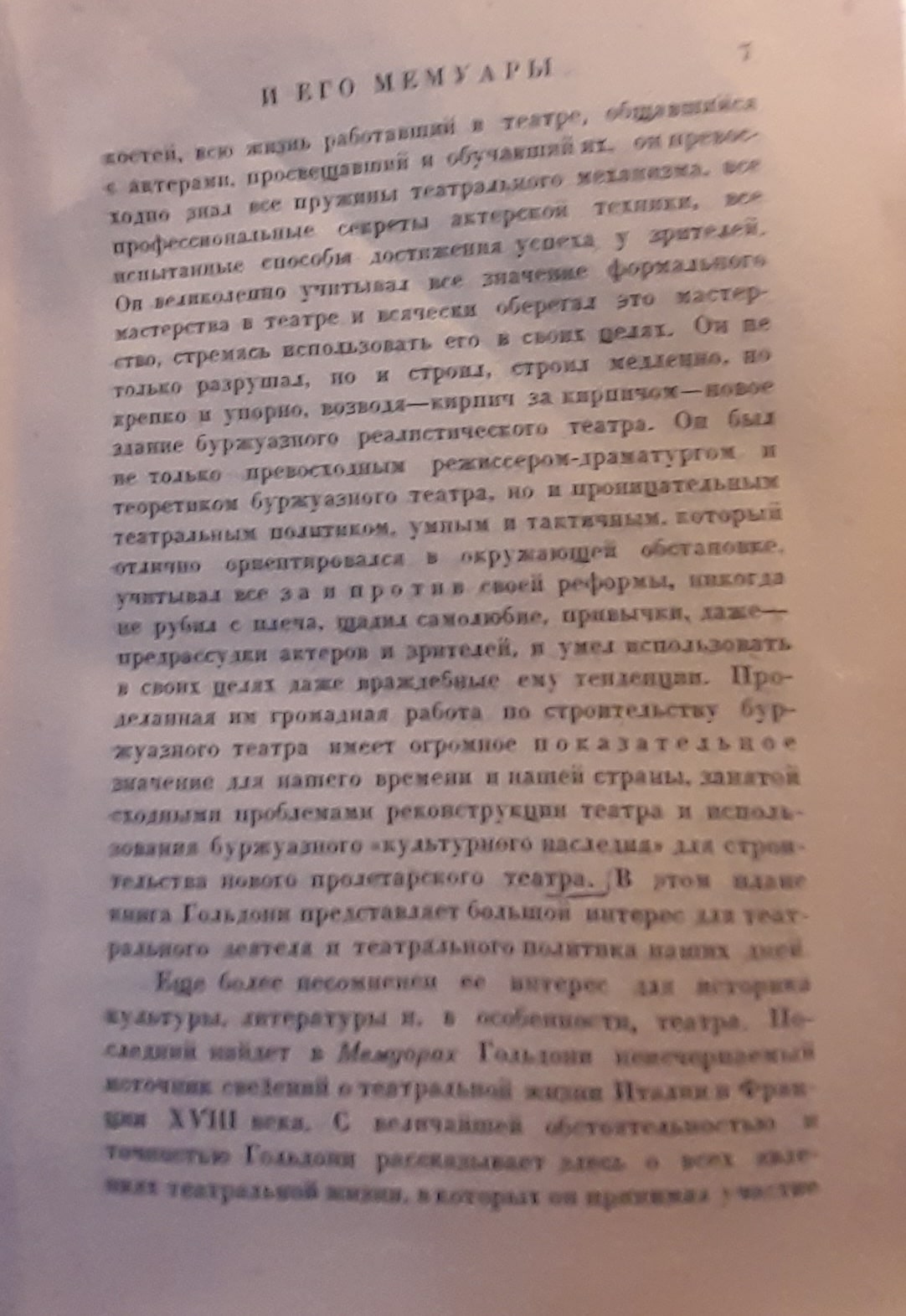
Captatio benevolentiae related to appropriation strategies: In the preface, Goldoni is portrayed as a reformer of Italian theatre and the ideologue of a growing bourgeoisie. Theatre is used by him as an instrument of the class struggle functional to the re-education of society on the basis of bourgeois ethics. Goldoni is a builder of the bourgeois realist theatre. This work of his has exemplary value for our time and for our country, which is currently facing similar problems in the reconstruction of the theatre and the use of the bourgeois cultural heritage for the construction of the new proletarian theatre (D101). In this sense, Goldoni’s book is of great interest to modern-day politicians and theatre workers.
Author’s justification: Goldoni failed to grasp the spirit of the great revolutionary changes in late 18th century Paris where he lived because he was already very old. In any case, the Memoirs were written two years before the Revolution, so they cannot consider it. For the same reasons (Goldoni’s age and official position at the court of Ludovic XVI), the Memoirs do not reveal the fervent critic of autocracy, serfdom, class privileges and aristocratic morality that Goldoni actually was; neither does Goldoni the moralist and educator of the third class emerge at all.
Relationship to the Directives: the political part of the preface is explicitly influenced by Friche’s sociological theorising, with which Soviet literary criticism was still steeped in 1930, before the closure of RAPP.
Author’s contribution: in addition to Mokulsky’s overt aim, namely to draw Soviet readers’ attention to the classical heritage of Italian theatre, it is also interesting how, when speaking of Goldoni’s exemplary value for Soviet theatre, he emphasises some important aspects of Goldoni’s struggle: 1. The great Venetian not only destroyed but also built; 2. He understood every importance of the formal art of theatre and cultivated it by trying to use it to his own ends; 3. He never made excessively drastic sacrifices, was indulgent with the habits and prejudices of actors and spectators, and even knew how to take advantage of tendencies that were hostile to him. With these statements (part of which is also highlighted in italics) Mokulsky seems to be trying to convince the critics (and their leaders) to imitate Goldoni’s lenient, cautious and thoughtful model in their fight against the formalist tendencies and avant-garde theatre of the 1920s.
Kristina Landa