Paratext collocation: Dante - Moskva -Žurnal'no-gazetnoe ob''edinenie - pp. 40-59
Paratext's typology: Teaching text (monograph)
Author of the paratext: Dživelegov Aleksej Karpovič
Author's bio:
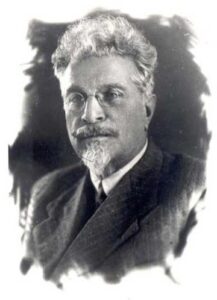
Aleksei Dzhivelegov (1875, Nakhichevan-on-Don - 1952, Moscow) was a distinguished scholar of Renaissance history and literature, as well as Italian theatre. He authored the first Soviet monograph on Dante and, throughout the 1930s and 1940s, was regarded as the preeminent authority in Italian studies within the USSR. Until 1937, he also headed the Italian literature series at the Academia publishing house.
Prior to the October Revolution, Dzhivelegov was a member of the Constitutional Democratic Party. Even during the Tsarist era, he employed a historical and sociological methodology in his analysis of literary works. In the Stalinist period, he adhered to a Marxist analytical framework, yet his scholarship consistently transcended the limitations of what was termed "vulgar sociologism." His particular talent for crafting "sociological prefaces" was notably acknowledged by the translator Mikhail Lozinsky, who asked Dzhivelegov to contribute a detailed introduction to his Russian translation of the Vita of Benvenuto Cellini.
Bibliography: M. Andreev, A.K. Dzhivelegov, in Literatura Italii. Temy i personazhi, Moskva, RGGU, 2008, pp. 308-318; RGALI. F. 2032. Dzhivelegov A.K.
Date of the paratext: 1933
Paratextual directives:
Author image:
Title of the original work translated into Russian: Vita nuova
Publication date of the original work: 1294/1295
Country of the original work: Italy
Author of the original text: Alighieri Dante
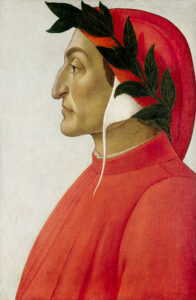
Bio of the Author (original text): Dante Alighieri (1265, Florence - 1321, Ravenna) - Italian poet considered the father of the Italian language and the greatest of the three Florentine 'crowns' (Dante, Petrarch, Boccaccio). Author of the books Rime, Vita Nuova, Convivio, Fiore, Detto d'Amore, Commedia (in Vulgar Italian), De vulgari eloquentia, Monarchia, Epistole, Egloghe (in Latin). See https://www.danteonline.it/opere/index.php&; https://dante.dartmouth.edu/
Author image:
Title of the Russian translation: Novaja žizn'
Collocation of the translation: Moskva – Academia
Translator's name: Èfros Abram Markovič
Translator's bio: Abram Markovich Efros (1888, Moscow - 1954, Moscow) - art critic, literary critic, translator, theatre historian, member of the administration of Moscow's most important museums in the 1920s. Already in his university years, he translated the Song of Songs from ancient Hebrew (1909), was the author of several translations from French and Italian, and composed essays on Aleksandr Pushkin, Michelangelo, Paul Valéry and other artists and men of letters. He was also the author of a collection of erotic sonnets (Eroticheskiye sonety, 1922). In the 1930s, Efros was chief editor of the Frantsuzskaya literatura series at the Academia publishing house. According to M. Rac, Efros' paratexts to translations of French works often represent small masterpieces (Rac 1989: 13). In 1937, he was arrested and sent into exile for three years in the city of Rostov Velikiy. In 1950, during the anti-Jewish repressions against the 'cosmopolitans', he was sent into exile in Tashkent, where he worked until his death as a professor at the State Institute of Theatre Art in Tashkent.
Curator of the Russian translation: Dživelegov Aleksej Karpovič
Russian translation publication date: 1934


Concise description of the paratext-directives' relation:
Dante is a poet of the rising bourgeoisie. The image of Beatrice is comparable to Boccaccio’s women in its vitality. VN contains many traits of realism. The significance of the VN also lies in the elaboration of a new poetic language that will also be used in the Commedia. Such language has its roots in the popular and uncultured poetry of 13th century Italy. The central sonnets are characterised by simplicity and clarity (D006; D011; D012; D121; D122; D123).
Kristina Landa