Gerbert Uells na perelome [P013]
Paratext collocation: "Vestnik inostrannoj literatury" [rivista], 1 - pp. 205-212
Paratext's typology: Essay
Author of the paratext: Dinamov Sergej Sergeevič
Author's bio: Sergey Sergeyevich Dinamov (Oglodkov, 1901-1939), literary critic, editor-in-chief, Shakespeare scholar and among the first Soviet Americanists, was a prominent figure in Soviet culture of the 1920s and 1930s. Having joined the Communist Party in 1919, Dinamov served in the Red Army until 1926. In 1923, he began working as a literary critic and, in 1926, undertook doctoral studies at the Academy of Social Sciences (RANION), specialising in English and American literature under the supervision of Vladimir Friche. After his doctorate, he became head of the Department of Methodology of Literature at Moscow State University (1930-1931). In 1930, he took over the editorship of "Literaturnaya gazeta", turning it into a point of reference for international literature: under his editorship, articles by authors such as Johannes Becher, Romain Rolland and Theodore Dreiser were published. With Dreiser he also maintained a personal correspondence. After a brief interlude as Vice-President of the Western Literature Section at the Communist Academy (1931), he returned to direct the "Literaturnaya gazeta" between 1932 and 1933. During the same period, he held important positions in the Party as director of the Institute of Red Professors (IKP) and, from 1932, as head of the art sector of the Central Committee of the Communist Party. Dinamov was on close terms with Maxim Gorky and, in 1932, he dedicated the book M. Gorky i Zapad (M. Gorky and the West, М., Zhurnal'no-gazetnoye ob'edinenie) to him. At the same time, he worked on the dissemination of Anglo-American literature in the USSR, with essays on Shaw (Bernard Shou, Moskva-Leningrad, GICHL, 1931), H.G. Wells, London, Twain, Poe, Reed and Dreiser; of the latter he edited the first Soviet edition of the complete works. From 1933 Dinamov became editor-in-chief of the magazine "Internacional'naya literatura", which under his leadership published works by Hemingway and Joyce, among others. In 1934, in particular, the magazine hosted stories by Dreiser, Anderson and Dos Passos, while in 1935 extracts from Huxley's Brave New World appeared. He worked, together with Aleksandr Smirnov, also on the eight-volume Soviet edition of Shakespeare's works (Academia - Goslitizdat, 1936-1950) and was the author of monographs on the English playwright. At the same time, he led the Anglo-American commission of MORP (International Organisation of Revolutionary Writers) and later chaired the entire organisation, actively participating in the International Congress of Writers for the Defence of Culture in Paris in 1935, shortly before the dissolution of MORP itself. His openness to 'bourgeois' Western literature cost him dearly. In 1937 he attempted to publish in the USSR George Orwell's The Road to Wigan Pier (1936), who at that time was militating in the ranks of the anti-Stalinist Workers' Party of Marxist Unification (POUM), a fact that could compromise Dinamov's position in the eyes of the Soviet authorities. On 26 September 1938, he was arrested and spent seven months in Lefortovo Prison; on 15 April of the following year, he was sentenced to death by the Supreme Court of the USSR on charges of being part of a counterrevolutionary terrorist organisation and shot the next day. He is buried in the mass grave in Kommunarka, Moscow region. In 1956 he was rehabilitated. Dinamov left a deep mark on Soviet literary criticism, contributing to the spread of western culture in the USSR. Ilaria Aletto Bibliography: Dinamov, in Literaturnaya ėntsiklopediya: V 11 tt., 1929-1939, A.V. Lunacharsky (otv. red.), Moskow, Izd-vo Kom. Akad., 1930, vol. 3, col. 310; A.N. Nikolyukin, Dinamov, in Kratkaya Literaturnaya ėntsiklopediya, 1962-1978, (red.) A.A. Surkov, Moscow, Sovetskaya ėntsiklopediya, 1964, vol. 2, col. 696.
Date of the paratext: 1929
Paratextual directives:
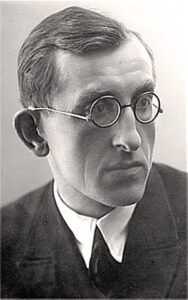
Author image:
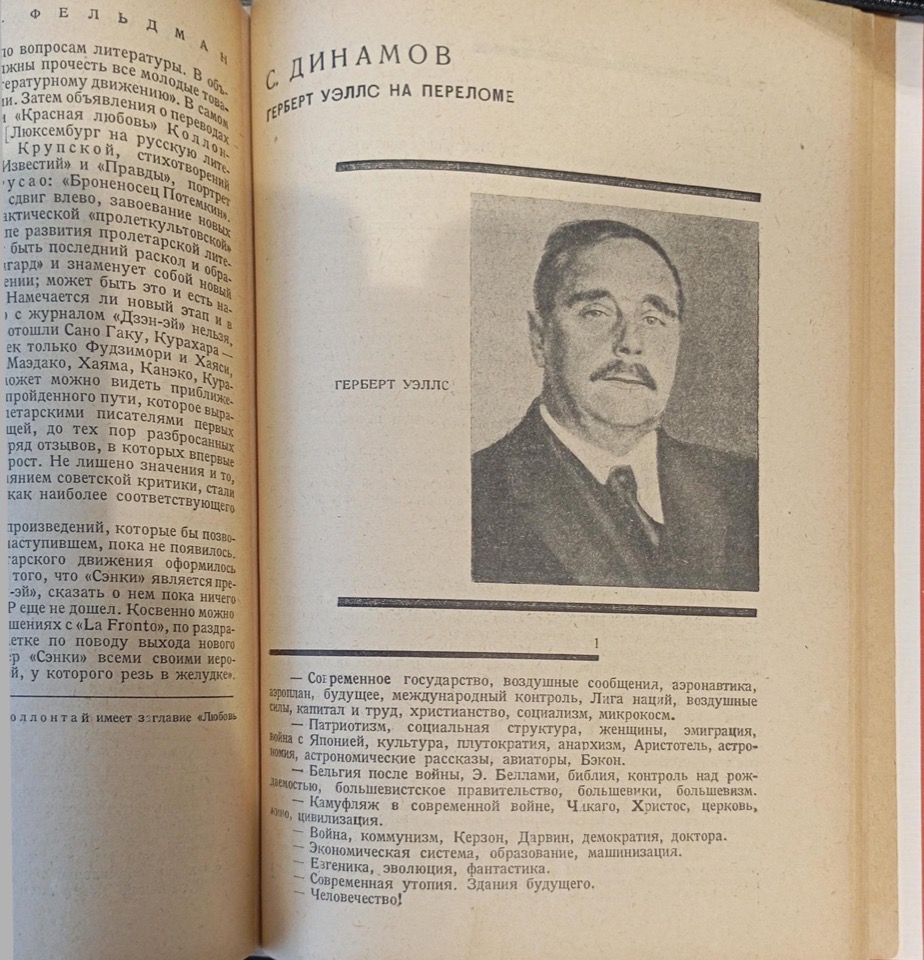
Title of the original work translated into Russian: Mr. Blettsworthy on Rampole Island
Publication date of the original work: 1928
Country of the original work: United Kingdom
Author of the original text: Wells Herbert George
Bio of the Author (original text): Herbert George Wells (1866-1946), British writer, journalist and essayist, is considered one of the founding fathers of science fiction. Wells explored themes of scientific progress, its ethical and social implications, as well as dystopia and social criticism in his writings. His vast and varied literary output ranges from novels to non-fiction, and is characterised by a marked ability to anticipate the major themes and challenges of the future. Wells' works are intrinsically linked to the great social and technological transformations of his era. Born in Bromley, Kent, Wells came from a family of modest means. After a childhood marked by financial difficulties and an irregular schooling, he managed to obtain a scholarship to the Normal School of Science in London (now part of Imperial College), where he studied biology under Thomas Henry Huxley, a leading proponent of Darwinian evolutionism. This experience profoundly influenced his worldview and literary production. H.G. Wells made his debut as a novelist in 1895 with The Time Machine, a pioneering work that laid the foundation for the modern science fiction genre by introducing the concept of time travel. Other highly successful novels followed, such as The Island of Dr. Moreau (1896), The Invisible Man (1897) and The War of the Worlds (1898), which, while falling within the genre of adventure fiction, proved to be powerful instruments of social criticism, offering a sharp analysis of the vices and contradictions of Victorian society. In the course of his career, Wells broadened his literary horizon, also devoting himself to realistic fiction, with novels such as Kipps (1905) and Tono-Bungay (1909), and to non-fiction, dealing with topics such as politics, history and science. Among his most influential essays are The Outline of History (1920) and The Open Conspiracy (1928), in which he outlined his vision of a rational and scientific world order. Wells had a complex relationship with the Soviet Union, which he visited several times, showing an alternating interest between curiosity and criticism. His first visit was in 1914, shortly before the outbreak of World War I, when he travelled to Russia to closely observe the political and social conditions of the Tsarist Empire. This trip provided him with an initial contact with the Russian reality and helped shape his views on the need for radical change. In 1920, he returned to post-revolutionary Russia motivated by a great interest in the transformations taking place. During this trip he met Vladimir Lenin, with whom he had a conversation about revolution, socialism and the role of science in Soviet society. Wells was impressed by Lenin's intelligence and analytical lucidity, while maintaining reservations about the new system's real chances of success. His observations on this experience were collected in the book Russia in the Shadows (1920), in which he described the difficult economic and social conditions in post-revolutionary Russia and the chaos resulting from the civil war. This text, although lacking open condemnation, highlighted the fragility of the new Soviet state and sparked a heated debate between Western and Soviet intellectuals. In 1934, Wells returned to the Soviet Union for a second major trip, during which he met Josef Stalin. The meeting with Stalin on 23 July in Moscow was characterised by a long dialogue in which Wells asked direct questions about economic policy, industrialisation and the role of the individual in the socialist state. Stalin presented himself as a pragmatic leader, committed to the modernisation of the USSR, emphasising the success of the five-year plan. Wells, unlike other Western intellectuals, was initially optimistic about Stalin's leadership, seeing him as a builder of a new social order. However, in later years, he became more critical of the Soviet regime, especially with regard to political repression, the lack of freedom of expression and the ideological rigidity imposed by the government. In Russia and the Soviet Union, Wells' works were translated and published with great interest from the early years of the 20th century. His science fiction fascinated Russian audiences, while his socio-political writings were carefully analysed by intellectuals and Soviet government officials. After the October Revolution, Wells was seen as an author who reflected the tensions between scientific progress and social transformation, and his works were published with increasing attention from Soviet publishers. However, his critical stance towards Stalinism led, in the following years, to a decreased circulation of his texts in the USSR, especially those of a political nature. The debate on Wells among Soviet critics oscillated between recognition of the value of his scientific insights and ideological suspicion of his ideas on liberalism and world governance. An active supporter of socialism and a strong critic of the capitalist system, elements that emerge in many of his works, in the last years of his life he manifested a growing pessimism towards the future of humanity, marked by the advent of World War II and the threat of nuclear weapons. Wells' works have had a lasting impact not only on science fiction literature, but also on popular culture and political thought in the 20th century. His ability to anticipate scientific and technological developments, combined with a profound reflection on the human condition, has made his novels still relevant today and the subject of numerous film adaptations and film adaptations. Ilaria Aletto Bibliography: R. Cockrell, Future Perfect: H. G. Wells and Bolshevik Russia, 1917-32, in The Reception of H. G. Wells in Europe, eds. P. Parrinder, J.S. Partington, New York, Thoemmes Continuum, 2005, pp. 74-90; G. Diment (ed.), H. G. Wells and All Things Russian, London, Anthem Press, 2019; Ju. Kagarlickij, Vgljadyvajas' v grjaduščee: Kniga o Gerberte Uėllse, Moskva, Kniga, 1989; M. Kozyreva, V. Shamina, Russia Revisited, in The Reception of H. G. Wells in Europe, eds. P. Parrinder, J.S. Partington, New York, Thoemmes Continuum, 2005, pp. 48-62; A. Ljubimova, B. Proskurnin, H.G. Wells in Russian Literary Criticism, 1890s-1940s, in The Reception of H. G. Wells in Europe, eds. P. Parrinder, J.S. Partington, New York, Thoemmes Continuum, 2005, pp. 63-73; N.C. Nicholson, H.G. Wells, in Encyclopaedia Britannica, Encyclopaedia Britannica, Inc., 2025, https://www.britannica.com/biography/H-G-Wells (accessed 5 October 2025).
Author image:
Title of the Russian translation: Mister Bletsuorsi na ostrove Rėmpol’
Collocation of the translation: "Vestnik inostrannoj literatury" [rivista], 1 – pp. 3-121
Translator's name: L.V. Špigel’
Translator's bio: N/A
Curator of the Russian translation: A.V. Lunačarskij, all'epoca direttore (otv. red.) del "Vestnik inostrannoj literatury"
Russian translation publication date: 1929


Concise description of the paratext-directives' relation:
Dinamov notes the extraordinary prolificacy of H.G. Wells, whose literary output spans 94 works, and his unique position in the English literary landscape. The comparison with Bernard Shaw underlines the originality with respect to the Irish writer, placing him in a position of his own. Indeed, Wells is considered one of the three greatest English writers of his time, together with James Joyce and John Galsworthy (novelist and playwright, future Nobel Prize winner for literature in 1932), as well as the one and only undisputed world master of the science fiction genre. Among Wells’ most significant ideological contributions are his lucid critique of bourgeois society, seen as an obstacle to scientific and technological progress, and his analysis of the subaltern condition of the proletariat. At the same time, Dinamov points to a certain class ‘myopia’ in Wells: the writer does not seem to grasp the emergence of communism, remaining rather anchored in a strictly capitalist perspective. The weakness of the writer’s ideology, the critic continues, lies in the proposal of an enlightened dictatorship, entrusted to an educated minority, as the only solution to social contradictions. This perspective denotes Wells’ lack of understanding of revolutionary processes and class struggle (on the ‘errors’ of Wells and other contemporary writers from his country, see D084). In conclusion, the Wellsian ideology presents itself to Dinamov’s eyes as a complex web of contradictions. On the one hand, the writer stands in clear opposition to capitalism, on the other, he seems to lean towards a kind of alliance with it, while rejecting the theory of class struggle.
Ilaria Aletto, Maria Zavyalova